

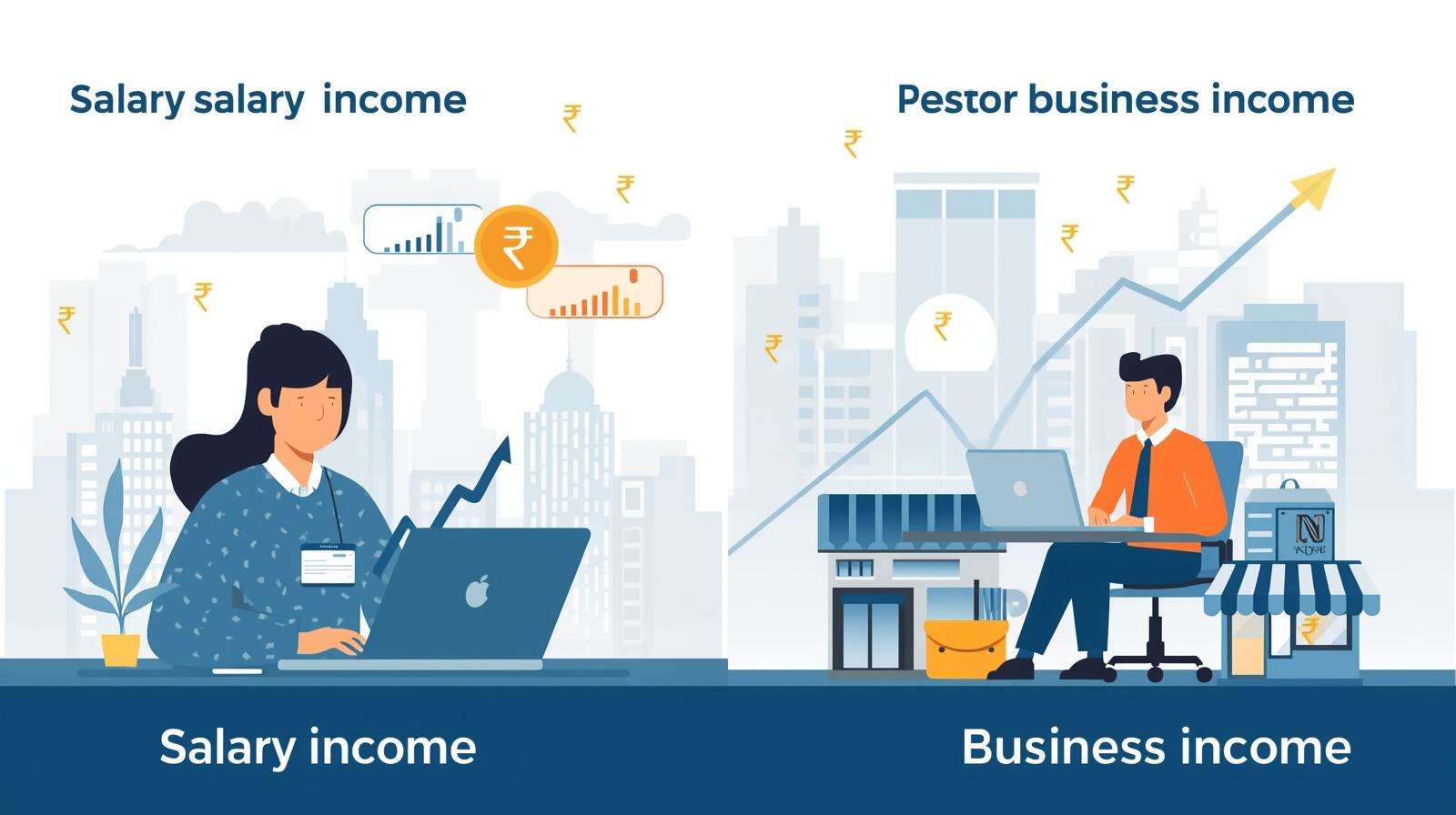
The debate between salary vs business income has never been more relevant for ambitious Nepalis seeking financial freedom in 2026. As Nepal’s economy transforms with digital innovation and entrepreneurial opportunities, the question isn’t just about earning money—it’s about building generational wealth. Whether you’re a fresh graduate weighing career options or a mid-career professional contemplating entrepreneurship, understanding the wealth-building potential of each path is crucial for your financial future.
The Wealth Creation Landscape in Nepal (2026)
Nepal’s financial landscape is experiencing a seismic shift. The proliferation of fintech platforms, e-commerce ecosystems, and digital payment systems has democratized wealth creation like never before. Young entrepreneurs are launching startups from their living rooms, while professionals in multinational corporations enjoy unprecedented salary packages. This modern financial shift has fundamentally altered how Nepalis approach wealth accumulation.
The core dilemma facing today’s workforce is clear: Should you pursue the stability and progressive growth of a salaried position, or embrace the high-risk, high-reward world of business ownership? The answer, as we’ll explore throughout this comprehensive analysis of salary vs business income, depends on your risk tolerance, capital availability, time commitment, and long-term financial goals.
The Salaried Path: Stability and Progressive Growth
For millions of Nepalis, a steady paycheck represents security and peace of mind. But can a salary truly build substantial wealth? The salary vs. business income comparison begins with understanding the potential and limitations of employment compensation.

Current Salary Benchmarks in Nepal
The employment income landscape in Nepal varies dramatically by sector and experience level. According to recent labor market data, the average monthly salary ranges from NPR 19,550 to NPR 150,000. Entry-level positions typically start near the minimum wage, while mid-career professionals in banking, IT, and telecommunications can command NPR 60,000 to NPR 100,000 monthly. Senior experts and executives in multinational corporations often exceed NPR 200,000, with some C-suite positions reaching NPR 300,000 or more.
The government has established a minimum monthly wage of NPR 19,550 as of July 2025, ensuring a baseline for all formal sector employees. This wage floor provides a safety net but highlights the importance of skill development and career progression for meaningful wealth accumulation. When evaluating salary vs business income for wealth building, these benchmarks provide important context for employment earning potential.
Tax Efficiency for Employees: Maximizing Wealth Retention
One often-overlooked advantage in the salary vs business income comparison is the tax efficiency available to salaried employees through strategic deductions. Nepal operates a progressive tax system with rates ranging from 1% to 39%, meaning higher earners face steeper tax obligations. However, the tax code offers several legitimate deductions that can substantially reduce your taxable income.
Retirement Contributions: Contributions to the Employees’ Provident Fund (EPF), Citizens Investment Trust (CIT), and Social Security Fund (SSF) are fully deductible, allowing you to build retirement wealth while reducing current tax liability. For someone earning NPR 100,000 monthly with a 10% EPF contribution (NPR 10,000), that’s NPR 120,000 in annual deductions—a significant advantage when comparing salary vs business income tax treatment.
Insurance Premiums: Life insurance premiums up to NPR 40,000 annually are deductible, as are medical insurance premiums up to NPR 20,000. Combined, a married couple could claim up to NPR 120,000 in insurance deductions while simultaneously protecting their family’s financial future.
Female Taxpayer Rebate: Women filing individual tax returns receive a 10% rebate on their computed tax liability, providing an additional wealth retention advantage. For a female professional with a tax bill of NPR 200,000, this rebate translates to NPR 20,000 in savings annually—money that can be reinvested into wealth-building vehicles.
Consider this example: A female IT professional earning NPR 1,500,000 annually (NPR 125,000 monthly) who maximizes her EPF contributions (NPR 150,000), life insurance deductions (NPR 40,000), and medical insurance deductions (NPR 20,000) reduces her taxable income to NPR 1,290,000. After applying the progressive tax rates and the 10% female rebate, her effective tax rate drops significantly, allowing her to retain more capital for investments. This tax optimization strategy is crucial when evaluating salary vs business income for long-term wealth building.
The Salaried Wealth-Building Formula
The path to wealth through employment income requires discipline and strategic financial planning. With a stable monthly income, you can build an emergency fund covering 6-12 months of expenses, contribute consistently to retirement accounts leveraging compound interest over decades, qualify for home loans and vehicle financing at favorable rates, invest systematically in mutual funds, stocks, or fixed deposits, and develop skills through professional certifications that increase your earning potential.
The mathematical reality of salaried wealth creation is straightforward but demanding: Save 30-40% of your monthly income, invest in diversified assets yielding 10-15% annual returns, and maintain this discipline for 15-20 years. A professional earning NPR 100,000 monthly who saves NPR 35,000 and invests it at 12% annual returns will accumulate approximately NPR 2 crore in 20 years—a substantial nest egg by any measure. Understanding this timeline is essential when comparing salary vs business income, wealth creation velocity.
However, this approach has inherent limitations. Your wealth-building velocity is constrained by your salary ceiling, and most corporate positions have defined compensation bands. While promotions and job changes can boost your income, exponential growth remains elusive in the salaried world—a critical factor in the salary vs business income equation.
The Entrepreneurial Route: High Risk for Exponential Rewards
When examining salary vs business income for wealth creation, the entrepreneurial path presents a starkly different proposition. Business ownership offers unlimited earning potential but demands significant personal sacrifice, capital investment, and risk tolerance.
Unlimited Earning Potential
Unlike the fixed compensation of employment, business income scales with market demand, operational efficiency, and strategic execution. A successful restaurant owner might earn NPR 500,000 monthly during peak seasons, while a software development agency could generate NPR 2-3 crore annually. The ceiling on business profits is determined by market size, not corporate pay scales—a fundamental difference in the salary vs business income dynamic.
This scalability advantage becomes even more pronounced when you consider business valuation. A profitable enterprise isn’t just generating monthly income—it’s building a saleable asset. A business producing NPR 50 lakh in annual profit might be valued at NPR 2-4 crore when sold, creating a wealth exit opportunity that salaried employment simply cannot match. This asset creation potential is perhaps the most compelling argument in the salary vs business income debate.
Lucrative Incentives for Startups in Nepal
The Nepalese government has implemented aggressive tax incentives to stimulate entrepreneurship and job creation, fundamentally altering the salary vs business income calculation for would-be entrepreneurs.
Startup Tax Holiday: New businesses registered under the startup category with annual turnover under NPR 10 crore enjoy a complete tax exemption for their first five years of operation. This means every rupee of profit remains with the entrepreneur to reinvest, scale operations, or accumulate personal wealth. For a startup generating NPR 30 lakh in annual profit, this five-year holiday translates to approximately NPR 1.5 crore in tax savings—capital that can accelerate growth exponentially. This incentive dramatically shifts the salary vs business income equation in favor of entrepreneurship.
IT Export Advantage: Recognizing the potential of Nepal’s technology sector, the government taxes IT companies exporting services at an effective rate of just 5% on net profit. This preferential treatment makes software development, digital marketing agencies, and IT outsourcing businesses extraordinarily tax-efficient vehicles for wealth creation. An IT export company earning NPR 1 crore in profit pays only NPR 5 lakh in taxes, compared to a salaried employee at similar income levels who might face a 36-39% effective tax rate—a stark contrast in the salary vs business income tax comparison.
Zero-Transaction Rule: For FY 2082/83, businesses reporting zero transactions pay zero tax, providing flexibility for early-stage ventures still seeking product-market fit or seasonal businesses with irregular revenue patterns. These regulatory accommodations make the salary vs business income choice more attractive for risk-tolerant individuals.
Wealth Distribution Insights: What the Data Reveals
National survey data provide compelling evidence for business income’s wealth-building superiority. According to Nepal Living Standards Survey findings, the wealthiest quintile of Nepali households derives the majority of its income from business and service enterprises, while the poorest segments rely predominantly on salaries and wages. This statistical reality isn’t coincidental—it reflects the structural differences between capped employment compensation and scalable business profits, offering empirical validation in the salary vs business income debate.
The data reveals that households in the top 20% income bracket typically combine multiple income streams, with business ownership serving as the primary wealth engine. These families might operate retail establishments, construction firms, import-export businesses, or professional services while also maintaining some salaried income for stability. The entrepreneurial component, however, drives their ascent into higher wealth tiers—a pattern that consistently emerges when analyzing salary vs business income across wealth segments.
The Harsh Reality: Business Failure Rates
The entrepreneurial dream comes with sobering statistics. Approximately 90% of new businesses fail within their first five years, according to global entrepreneurship research that mirrors patterns observed in Nepal. Common failure factors include inadequate capital, poor market research, weak cash flow management, competitive pressure, and inability to adapt to changing market conditions. This failure rate is a critical consideration in any honest salary vs business income analysis.

The financial consequences of business failure extend beyond lost investment. Entrepreneurs often deplete personal savings, incur debt, and sacrifice years of potential salaried income during their venture. For every success story of a business owner building multi-crore wealth, dozens of failed attempts that never achieve profitability.
However, those who succeed often achieve wealth accumulation that would require 30-40 years of high-salary employment to match. The risk-reward profile is extreme, making the salary vs business income decision fundamentally a question of your risk appetite and entrepreneurial capability.
The “Middle Path”: Freelancing and Digital Entrepreneurship
Between traditional employment and full-scale business ownership lies an increasingly popular wealth-building strategy: freelancing and digital entrepreneurship. This hybrid approach offers unique advantages in the salary vs business income comparison, essentially creating a third option that combines elements of both.
Simplified Tax for Freelancers
Nepal’s tax framework provides exceptional benefits for digital workers and freelancers earning foreign currency. Those with annual income under NPR 40 lakhs pay a flat 5% final tax on their earnings—a rate substantially lower than the progressive tax brackets that trap high-earning salaried professionals. This tax advantage creates an interesting middle ground in the salary vs business income analysis.
Consider the math: A freelance graphic designer earning NPR 35 lakhs annually (approximately NPR 2.9 lakhs monthly) through international clients pays only NPR 1.75 lakhs in taxes. A salaried employee with identical income would face progressive taxation potentially exceeding 25% after considering all applicable brackets, resulting in a tax bill of NPR 6-7 lakhs or more. This NPR 4-5 lakh difference in annual tax liability represents capital that freelancers can invest in wealth-building instruments. When evaluating salary vs business income, freelancing emerges as a tax-optimized hybrid model.
The 5% final tax rate transforms freelancing into one of the most tax-efficient income strategies available in Nepal, particularly for skilled professionals in writing, design, programming, digital marketing, and consulting who can access global client markets. This efficiency challenges the traditional salary vs business income binary by introducing a third pathway with unique advantages.
Low Barrier to Entry
Digital entrepreneurship requires minimal upfront capital compared to traditional businesses. A freelance software developer needs only a laptop and an internet connection—perhaps NPR 100,000 total investment—to begin earning. A content writer can launch with even less. There are no inventory costs, no commercial rent, no employee salaries, and no regulatory compliance burdens during the initial phases.
This accessibility makes freelancing an ideal testing ground for entrepreneurial aspirations. Professionals can maintain salaried employment while building a freelance practice during evenings and weekends, gradually transitioning to full-time self-employment as client relationships and income stabilize. The risk profile sits comfortably between the security of salary and the all-or-nothing nature of traditional business ownership—offering a pragmatic middle path in the salary vs business income decision framework.
Platforms like Upwork, Fiverr, Freelancer, and Toptal connect Nepali talent with international clients willing to pay premium rates for quality work. A skilled Nepali web developer might charge $40-60 per hour on these platforms—dramatically higher than local market rates—while still remaining competitive against American or European freelancers charging $100+ hourly.
The freelancing model also offers lifestyle advantages that impact long-term wealth building. Location independence allows you to minimize living costs by residing in affordable areas while earning international rates. Flexible scheduling enables skill development and multiple client relationships that diversify income streams. For many Nepalis, this middle path optimizes the salary vs business income equation by combining business income’s tax efficiency and scaling potential with employment’s lower risk profile.
Comparative Analysis: Risk, Time, and Control
Understanding the practical realities of salary vs business income requires examining the daily lived experience and long-term implications of each path. Beyond the numbers, the lifestyle implications significantly impact sustainable wealth building.
Time Commitment and Work-Life Balance
Salaried employment typically offers predictable hours—the standard 9-to-6 schedule that allows for personal time, family commitments, and leisure. While senior positions may demand occasional overtime and deadline pressures, most employees can disconnect after work hours. This predictability facilitates planning, reduces stress, and enables consistent personal routines that support health and relationships—advantages often overlooked when analyzing salary vs business income purely from a financial perspective.
Business ownership presents a starkly different reality. Entrepreneurs frequently describe their venture as a relentless commitment that consumes evenings, weekends, and holidays, particularly during the crucial early years. A restaurant owner must manage staff issues at 10 PM. An e-commerce entrepreneur monitors inventory and customer complaints on Sundays. A construction business owner personally oversees project sites before dawn.
This time intensity doesn’t necessarily decrease as the business matures. Growth creates new challenges—managing larger teams, handling more complex client relationships, navigating regulatory requirements, and competing against well-funded rivals. Many successful business owners report working 60-80 hours weekly for years or even decades. This lifestyle difference is a crucial non-financial factor in the salary vs business income decision.
The time equation in salary vs business income is therefore not merely about hours worked but about autonomy. Salaried employees trade their time for predictability and stability. Entrepreneurs invest extraordinary time with the possibility of eventually building systems that generate income with less direct involvement—the elusive goal of passive business income.
Control Over Your Financial Destiny
Perhaps the most psychologically significant factor in the salary vs business income decision is control. Salaried employees exist within corporate hierarchies where advancement depends on factors beyond their direct control: economic conditions, company performance, manager relationships, organizational restructuring, and market disruption. A talented professional might see their career stalled by a poor manager or eliminated by industry disruption.
Your salary growth follows corporate-defined compensation bands and annual review cycles. Exceptional performance might yield a 15-20% raise in extraordinary circumstances, but most increases cluster around 5-10% annually. Your income trajectory is largely predetermined by your industry, role, and company policies—a constraint that significantly impacts the salary vs business income wealth velocity comparison.
Entrepreneurs operate with radically different dynamics. Every strategic decision—pricing, marketing, product development, partnerships, expansion—directly impacts profitability and personal income. A clever marketing campaign can double revenue within months. An innovative service offering can open new market segments. A strategic partnership can transform business economics overnight. This control over outcomes is a defining characteristic in the salary vs business income comparison.
This control extends to branding and reputation building. Business owners craft their market position, define their value proposition, and shape public perception. Over time, this creates a personal brand and professional network that transcends any single venture, enabling serial entrepreneurship and consulting opportunities. The cumulative effect of this autonomy often yields opportunities that salaried employees rarely access—a qualitative advantage in the salary vs business income equation.
However, control is a double-edged sword. Business owners bear full responsibility for failures. There’s no corporate safety net, no HR department managing disputes, no legal team handling contracts. Every problem ultimately lands on the entrepreneur’s desk, creating psychological pressure that many find overwhelming when navigating the salary vs business income choice.
Market Volatility and Asset Creation
The risk profiles of salary vs business income diverge most dramatically when considering economic downturns and long-term asset creation. Salaried employment offers relative stability during economic contractions—companies reduce hiring and freeze raises, but established employees often retain their positions unless businesses collapse entirely. Your human capital (skills and experience) remains portable across employers, providing resilience against individual company failures.
Business ownership exposes you directly to market volatility. Revenue can plummet during economic downturns as customers reduce spending. Fixed costs continue regardless of sales, creating potential cash flow crises. The 90% failure rate within five years reflects how challenging it is to navigate evolving market conditions, competitive dynamics, and operational challenges—stark realities that must inform any salary vs business income decision.
Yet successful businesses create a transferable asset that a salary can never match. A profitable enterprise worth NPR 3-5 crore represents wealth that can be sold, transferred to children, or leveraged for additional capital. This business equity becomes a cornerstone of generational wealth transfer—something that families can build upon across decades. This asset creation potential fundamentally distinguishes salary vs business income from a multi-generational wealth perspective.
The salaried path creates no comparable asset. Your career might generate NPR 10-15 crore in lifetime earnings, but without disciplined savings and investment, this income flows through your hands without creating lasting wealth. The absence of a salable business asset means salaried wealth building relies entirely on converting income into investments—real estate, stocks, mutual funds—requiring discipline that many struggle to maintain. This difference in asset creation is perhaps the most significant long-term factor in the salary vs business income comparison.
The Hybrid Strategy: The Ultimate Wealth-Building Roadmap
The most sophisticated answer to salary vs business income may be: both. Strategic wealth builders increasingly adopt hybrid approaches that capture employment stability while pursuing entrepreneurial upside, recognizing that the question need not be binary.

Reinvesting Salary into Business Ventures
The fastest wealth creation trajectory often involves using salaried employment as a foundation for entrepreneurial experimentation. Your stable paycheck covers living expenses and provides financial security while you test business concepts with limited risk. This approach eliminates the pressure to generate immediate revenue from a new venture, allowing time for product development, market testing, and customer acquisition—effectively optimizing the salary vs business income equation by leveraging both simultaneously.
A software engineer earning NPR 150,000 monthly might invest NPR 50,000 into developing a mobile application during evenings and weekends. If the app fails, their financial foundation remains intact. If it succeeds, the app revenue might eventually exceed their salary, enabling a transition to full-time entrepreneurship with meaningful momentum and capital already built. This strategy represents a practical resolution to the salary vs business income dilemma.
This strategy addresses the primary weakness of both pure salary and pure business approaches. Salaried employees often struggle to accumulate enough capital to launch meaningful ventures. Pure entrepreneurs frequently undercapitalize their businesses due to limited personal resources. The hybrid approach solves both problems by using employment income to adequately fund business attempts while maintaining personal financial stability—a sophisticated perspective on salary vs business income that transcends either-or thinking.
Diversification: The Millionaire’s Secret
Nepal’s wealthiest individuals rarely rely on a single income source. They strategically diversify across multiple asset classes and income streams, optimizing the tax treatment and risk profile of each element. Rather than viewing salary vs business income as competing alternatives, they integrate both into comprehensive wealth strategies.
The most effective wealth-building formula combines:
Active Income (Salary or Business): Generates monthly cash flow for living expenses and investment capital. Whether from employment or entrepreneurship, this active income fuels the entire wealth-building engine. Many millionaires maintain both salary vs business income streams simultaneously, maximizing total compensation.
Share Market Investments: Equity investments in listed companies offer growth potential with favorable tax treatment. For Nepalese residents, dividends and capital gains from share trading are taxed at just 5%—remarkably efficient compared to progressive income tax rates. A diversified portfolio of banking, insurance, and manufacturing stocks can yield 12-20% annual returns during bull markets while providing liquidity that real estate lacks. These investments convert either salary or business income into passive wealth.
Real Estate Holdings: Property investment offers inflation protection, rental income potential, and moderate capital gains taxation at 2.5-5%. Land in developing areas around Kathmandu, Pokhara, or Butwal can appreciate 10-15% annually, while rental properties generate passive monthly income. Real estate also serves as collateral for business loans, creating leverage opportunities that accelerate wealth building regardless of whether you’re in the salary vs business income camp.
Fixed Income Securities: Government bonds, corporate debentures, and fixed deposits provide stability and predictable returns. While yields of 8-11% won’t generate extraordinary wealth alone, these instruments preserve capital during market volatility and ensure liquidity for opportunities or emergencies.
The specific allocation depends on age, risk tolerance, and financial goals, but the principle remains constant: diversification reduces portfolio volatility while capturing returns from multiple economic sectors and asset classes. This sophisticated approach transcends the simplistic salary vs business income debate by recognizing that optimal wealth building leverages every available advantage.
The Hybrid Timeline: A Practical Roadmap
For young professionals contemplating the salary vs business income question, consider this phased approach that integrates both paths strategically:
Phase 1 (Years 1-5): Foundation Building: Focus on salaried employment to develop professional skills, build an emergency fund, and accumulate investment capital. Live below your means, maximize tax deductions, and invest 30-40% of income systematically. Use this phase to educate yourself about business models, market trends, and entrepreneurial skills while maintaining financial stability. Don’t view this as choosing salary over business in the salary vs business income debate—view it as sequencing.
Phase 2 (Years 5-10): Experimentation: Launch side businesses or freelance ventures while maintaining employment. Test concepts with limited capital at risk. Build business skills in marketing, sales, operations, and finance. If a venture shows promise, reinvest profits to accelerate growth. If attempts fail, the financial impact remains manageable. This phase allows you to explore the salary vs business income question empirically rather than theoretically.
Phase 3 (Years 10-15): Transition: If your entrepreneurial ventures achieve sufficient scale and profitability, transition to full-time business ownership. Alternatively, continue the hybrid approach indefinitely if your salary provides benefits (health insurance, retirement contributions, professional development) that complement business income. The decision depends on which arrangement optimizes your total compensation and lifestyle preferences. By this phase, you’ve moved beyond salary vs business income as a binary choice to a customized optimization.
Phase 4 (Years 15+): Optimization: Focus on wealth preservation and passive income generation. Sell business interests if appropriate, or systematize operations to reduce personal involvement. Shift investment portfolios toward stability as retirement approaches. Transfer business equity to the next generation or convert to dividend-producing assets. At this stage, the salary vs business income question becomes less relevant as your wealth generates returns independent of active work.
This timeline isn’t rigid—some entrepreneurs launch successful ventures immediately after graduation, while others spend entire careers in salaried roles while building investment portfolios. The key insight is that salary vs business income need not be mutually exclusive paths but complementary elements in a comprehensive wealth strategy.
Conclusion: Choosing Your Path in Nepal
After examining the tax frameworks, earning potential, risk profiles, and practical realities of salary vs business income in Nepal, a clear pattern emerges: business income builds wealth faster for those capable of navigating its challenges, while salaried employment offers a proven lower-risk path to financial security.
The mathematical advantages of entrepreneurship are undeniable. The five-year startup tax holiday, 5% effective rate for IT exports, and unlimited earning potential create conditions for exponential wealth creation that salaried employment cannot match. The wealthiest Nepalis overwhelmingly derive their fortunes from business ownership, validating entrepreneurship’s superior wealth-building capacity for those who succeed. In the pure salary vs business income comparison, business wins on velocity.
However, the 90% failure rate and relentless time demands of business ownership mean this path suits only those with high risk tolerance, adequate capital, relevant skills, and genuine entrepreneurial drive. Mismatched entrepreneurs—those pursuing business ownership for the wrong reasons or without proper preparation—face financial devastation and years of lost opportunity. The salary vs business income decision must account for personal circumstances, not just mathematical potential.
For risk-averse individuals prioritizing stability, a high-salary role in banking, telecommunications, IT, or multinational corporations, combined with aggressive saving (30-40% of income), strategic tax deductions, and disciplined investing, remains a reliable roadmap to accumulating NPR 1-2 crore over 15-20 years. This timeline extends longer than entrepreneurial wealth creation but arrives with far greater certainty. In the salary vs business income equation, salary offers the lower-variance outcome.
The hybrid strategy—maintaining salaried employment while building business ventures or freelance income—offers the most balanced approach for most Nepalis. This combination provides financial security while creating opportunities for exponential gains, allowing you to test entrepreneurial concepts without catastrophic risk. Rather than choosing definitively in the salary vs business income debate, this approach captures advantages from both sides.
Ultimately, the salary vs business income decision is deeply personal, depending on your financial goals, risk tolerance, skills, capital availability, and life priorities. Wealth building isn’t a one-size-fits-all formula but a customized strategy that aligns your income sources, tax efficiency, investment vehicles, and time horizon with your vision of financial freedom in Nepal’s dynamic economy.
The question isn’t which path is universally superior in the salary vs business income comparison, but which path is right for you, given your unique circumstances and aspirations. Both employment and entrepreneurship have created millionaires in Nepal. Your task is to honestly assess your capabilities, resources, and goals, then commit to whichever approach—or hybrid combination—maximizes your probability of success.
In 2026 in Nepal, opportunities abound for those who choose wisely and execute diligently. The startup tax holidays favor entrepreneurs. The progressive tax system with deductions supports strategic salaried professionals. The freelancing regulations accommodate digital nomads. The investment markets reward disciplined allocators. Success is available regardless of whether you choose salary, business income, or some combination thereof.
The salary vs business income debate will continue as long as people seek financial freedom. But the most important insight is this: the choice matters less than the execution. A mediocre entrepreneur will fail despite favorable tax treatment. A disciplined salaried professional will accumulate wealth despite a slower velocity. Your income source is merely the engine—your financial discipline, strategic planning, tax optimization, and investment wisdom determine whether you reach your destination.
Whether your wealth engine runs on salary vs business income, commit fully to your chosen path, optimize relentlessly, adapt to changing conditions, and maintain the long-term perspective required for significant wealth accumulation. Nepal’s economy offers pathways to prosperity for those willing to work intelligently toward their financial goals, regardless of whether those goals are funded by employment compensation or entrepreneurial profits.
The salary vs business income question has no universal answer, but it has a personal answer for each of us. Discover yours, then execute with discipline and determination. Your financial freedom awaits, regardless of which path you choose.
Follow me in Facebook